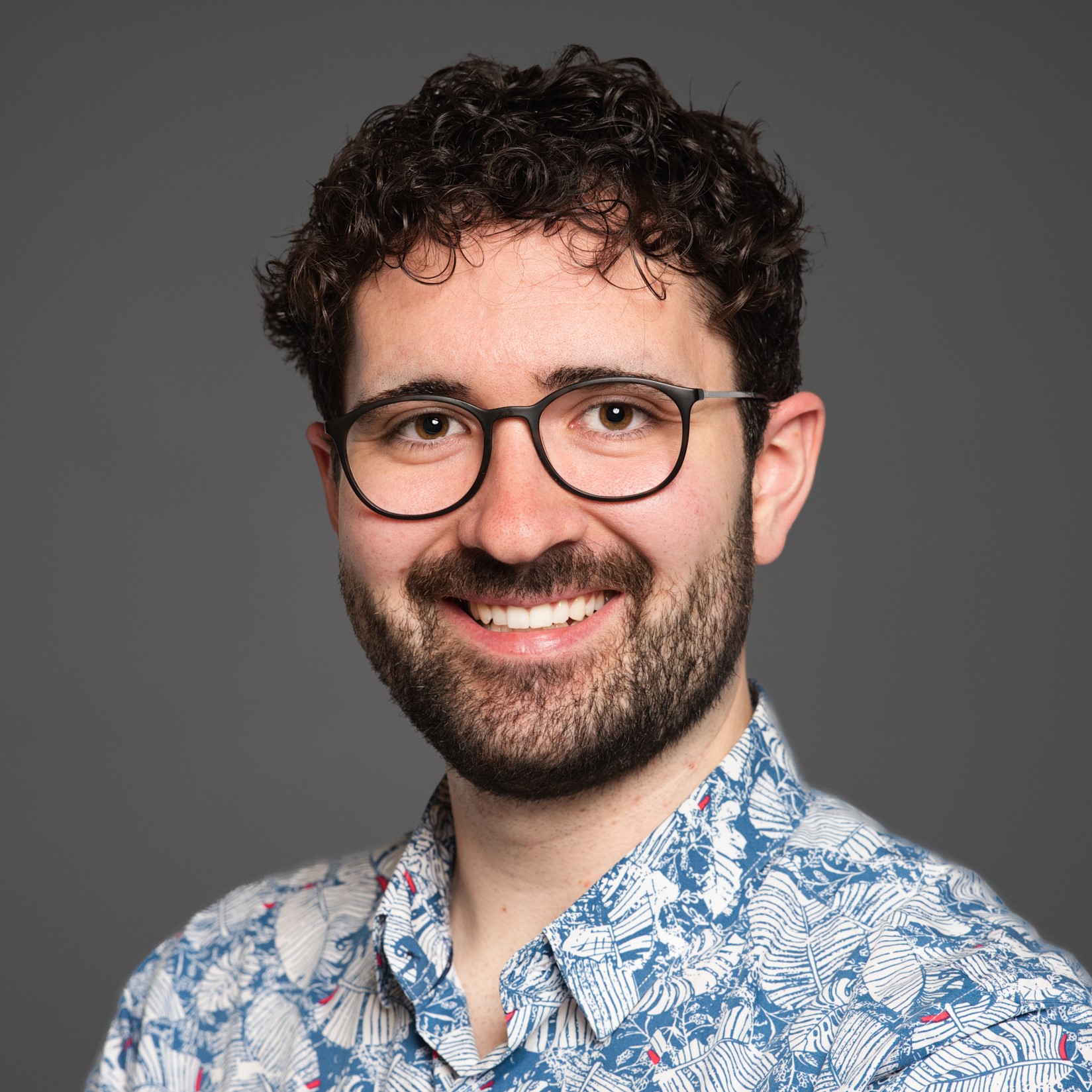
Ryley McConkey
PhD, P.Eng.
Email / Github / Google Scholar / LinkedIn / ORCID
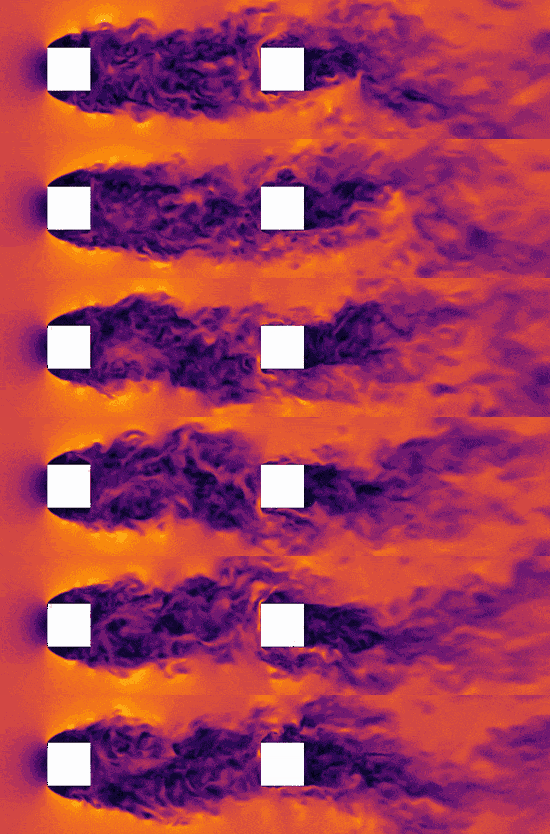
I’m a postdoc working with the Atomic Architects and Multiscale Mariners research groups at MIT. I build machine learning methods for fluid mechanics and turbulence, and I work on applying them to practical problems in engineering. My current work includes subgrid-scale modelling for LES, closure modelling and benchmarking for RANS, equivariant network architectures, and applications in ocean modelling and atmospheric re-entry. I love fluid mechanics, and computational fluid dynamics (CFD)! Check out my YouTube playlist, lectures, and blog posts.
Alongside my PhD, I spent five years doing engineering design, simulation, and research in industry. I designed medical devices like autoinjectors and aerosol containment devices at MACH32, automated CFD workflows at Orbital Stack, and developed machine learning models for wind engineering at RWDI. I’ve been a licensed Professional Engineer in Ontario since 2024.
Selected work
-
The Closure Challenge, a continuously running, field-wide benchmark for machine learning in RANS turbulence modelling, hosted under ERCOFTAC SIG 54. A decade of work in this area had produced no shared evaluation, so every study picked its own test flows. I started the benchmark and serve as benchmark steward. We have six international groups on the leaderboard so far. Check it out if you’re interested in ML for RANS! Preprint / Github
-
Realizability-informed machine learning, an equivariant model formulation for predicting the Reynolds stress anisotropy tensor in a realizable way. I replaced ad-hoc postprocessing of predicted anisotropy tensors with a physics-based loss that penalizes non-realizable predictions during training, inside a framework that keeps eddy-viscosity conditioning. JFM Paper
-
A curated dataset for data-driven turbulence modelling, the first open-source dataset built for immediate use in ML-augmented closure modelling, with collocated RANS and high-fidelity data for the same flows. 895,640 data points, five flow families, four turbulence models. Scientific Data Paper / Kaggle
-
Machine learning for constitutive modelling in CHEFSI, a DOE/NNSA PSAAP-IV Predictive Simulation Center at MIT. I lead the machine learning team (4-5 graduate students) on learning material response for thermal protection systems under atmospheric re-entry conditions. CHEFSI website
News
-
September 2026: I’m on the job market this cycle, for both faculty positions and industry research roles. Please get in touch :)
-
July 2026: We have a new preprint out on rotational equivariance and locality in data-driven subgrid-scale closures for LES. Check it out on arXiv.
-
April 2026: The Closure Challenge benchmark is fully live on github. We also put a preprint on arXiv discussing this challenge, but the github page is the main source of up-to-date information for the benchmark. Ongoing submissions are encouraged!
-
February 2026: We have a preprint out on how the rotational nature of turbulence teaches rotational equivariance to neural networks. This is a continuation of our work presented at NeurIPS ML for Physical Sciences. Check it out on arXiv.
-
December 2025: I’ll be at the NeurIPS ML for Physical Sciences workshop. We’re presenting a poster based on our accepted workshop paper on distributional symmetry in turbulence.
-
November 2025: I presented our abstract on equivariance for subgrid scale closure modelling at an Interact session at the APS DFD 2025 meeting (poster).
-
November 2025: Tyler Buchanan, Richard Dwight, Paola Cinnella, and I are putting together a continuously running, field-wide benchmark for RANS turbulence modelling. It’s time we had a standardized benchmark for machine learning in RANS! The data and evaluation package is now public. See the description here. It’s being advertised as part of the 2026 ERCOFTAC ML for Fluids Workshop (link), but it will run beyond the conference.
-
September 2025: We have a preprint out on distributional symmetry in turbulence, and how superresolution models can learn equivariance just from the rotational nature of turbulence data.
-
April 2025: I presented at the Chalmers University of Technology Data Science and Artificial Intelligence Seminar Series (slides). I also went to IKEA in Sweden. What else?
-
March 2025: I presented at the ERCOFTAC ML for Fluids Workshop in London (slides). It was a great workshop, and I enjoyed my time in London!
About me
I graduated from the University of Alberta in 2019 with a Bachelor of Science in Mechanical Engineering (co-op). Pursuing an interest in turbulence and computational fluid dynamics (CFD), I then began a Master’s degree at the University of Waterloo. In my Master’s research, I was focused on simulating a new type of wind turbine which uses vortex induced vibration (VIV) to generate energy. Then, I direct transferred to a PhD in 2020. My PhD was focused on developing new turbulence models using machine learning. I completed a 6 month visit at the University of Manchester in 2022-2023, where I focused on data-driven turbulence modelling on complex 3D flows. After completing my PhD in 2024, I started a Postdoc at MIT, funded by an NSERC Postdoctoral Fellowship.
My diverse experience includes mechanical design, software implementation, and industrial research and development. At MACH32, a medical device startup company, I was the sole simulation engineer and an inventor on three devices. I designed and simulated novel autoinjectors, along with a portable negative-pressure isolation tent that went from an emergency physician describing the problem to a device on the market in about 40 days during the first year of the COVID-19 pandemic. I designed and ran the experimental validation campaign behind its published performance specification, and it was adopted by University Health Network in Toronto. I also worked on automating CFD simulations as a Software Developer at Orbital Stack, a wind engineering startup company. In the Research and Development group (Labs) at RWDI, I developed and implemented machine learning based tools to augment simulations and wind tunnel experiments.
Outside work, I do landscape photography, play trombone in the MIT Concert Band, tutor at a Cambridge high school every week, and build hobby electronics.
Personal records
| Largest simulation | ~600,000 CPU hours: 30M cells on 512 cores, one week per run, several runs |
| Largest dataset | 500 TB ocean simulation on 1000 GPUs. Animation coming soon! |
| Largest model trained | > 30M parameters |
| Most GPUs at once | Four H100s for a week, multi-node |
| Largest tabular training run | 56M rows across four A100s. XGBoost, of course |
| Deadlift | 365 lb × 5 |
| Squat | 315 lb × 5 |
| Bench press | 195 lb × 4 |
| Hot dogs consumed at a sporting event | 6 |
Here is a playlist with my favourite fluid mechanics videos: